



Artificial intelligence is learning to listen, but what matters isn’t just that machines can hear. The real question is whether they can be trained to hear what humans consistently overlook. Subtle audio cues, imperceptible shifts in rhythm, timing, or resonance are now fueling breakthroughs across healthcare, manufacturing, and security. Sound, once the neglected modality of AI research, is becoming the new fault line between commodity annotation and specialized behavioral engineering.
Most commentary frames audio-based AI as a new frontier. In reality, it is a stress test. It reveals which companies can move beyond the “bulk food” era of labeling into the world of high-context, domain-specific intelligence. And it is already clear who is stumbling, who is adapting, and who is shaping the next phase.
Healthcare Hears a New Signal
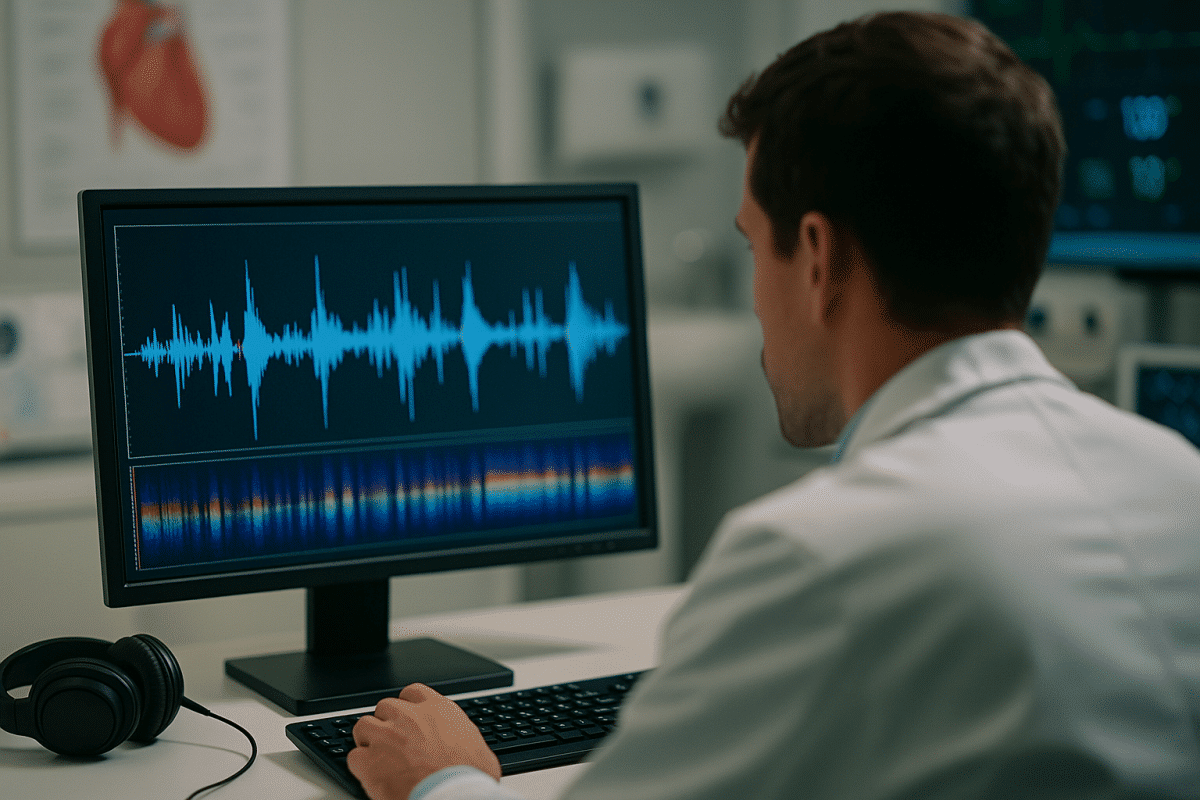
The stethoscope is a 19th-century instrument, but its reinvention is happening through annotation. AI models trained on carefully labeled auscultation clips are already outperforming junior clinicians in distinguishing benign murmurs from pathological ones.
The point is not that machines are replacing physicians. The point is that sound datasets, labeled with precision and context, are beginning to outperform the human ear. But annotation here is not the work of faceless clickworkers. The timing and tonal texture of a murmur can mean the difference between reassurance and a missed cardiac emergency. That kind of judgment requires clinical expertise, not just keystrokes.
Companies like Snorkel AI, Cogito Tech, and Surge AI have been adapting to this shift. Each has recognized in different ways that frontier AI requires annotation talent with professional-level context. Cogito drew on lessons from sectors like autonomous driving, where audio and multimodal signals were critical, to build clinical annotation teams early. Snorkel and Surge, once focused on automation and scale, now emphasize experts-in-the-loop, a shift that reflects how the entire field is converging on the same conclusion: generic annotation no longer suffices.
Beyond cardiology, voice analysis is moving into psychiatry. Early experiments suggest pitch, cadence, and coherence can correlate with depressive or manic states. Unlike questionnaire-based diagnostics, these signals are passive, ambient, and resistant to self-censorship. But again, without careful annotation across diverse populations, the risk of misinterpretation looms.
Industrial Machines Speak—But Not Everyone Understands the Dialect
In factories, turbines and conveyors have their own dialects, subtle changes in pitch or vibration patterns that precede mechanical failure. Humans rarely notice them until it is too late. AI systems trained on annotated audio samples are now surfacing those anomalies earlier, enabling predictive maintenance that cuts downtime, according to a 2025 Capgemini report.
But here too, annotation is the bottleneck. A conveyor belt in Shenzhen doesn’t sound like one in Stuttgart. Acoustics differ, background noise varies, and the same malfunction manifests differently across environments. Companies chasing scale with generalized datasets may fail here. Without context-specific annotation—exact machine, exact condition, exact setting—the models remain brittle.
Cogito, Snorkel, and Surge have each moved toward embedding specialized annotation teams alongside engineers, aiming to ensure that sound events are logged with context and precision rather than treated as raw inputs. This type of workflow offers capabilities that go beyond what commodity platforms or loosely crowdsourced pipelines can achieve. Firms like Invisible Technologies and Mercor are experimenting with orchestration models that coordinate distributed talent, but in industrial settings the tolerance for error is low. Misclassification is not an abstraction. This can result in delays to market, lost revenue, or serious operational risks.
Security Applications Move Beyond Visual Surveillance
Security has long been dominated by video feeds, but sound is becoming the new tripwire. Gunshots, breaking glass, and alarm tones trigger AI systems designed to accelerate response. The challenge is variability: a gunshot in an alley echoes differently than in a warehouse, and systems trained on narrow datasets collapse under real-world diversity.
Here, annotation at scale is meaningless. The value lies in breadth and realism. Incorporating context-rich, human-labeled audio from diverse geographies and acoustic conditions helps improve AI model accuracy by reducing false positives and enhancing overall reliability. This is not annotation as a mechanical process. It is applied judgment.
As Cogito’s Rohan Agrawal observed, “Audio is situational. It carries location, distance, and urgency. Without annotations that capture these layers, models are blind.” Unlike video, which can be spoofed, audio resists manipulation and provides context that imagery cannot. This is why the firms that survive in this space may be those who invest in high-trust annotation pipelines.
The Annotation Bottleneck Exposed
The industry wants automation to make annotation disappear. Yet audio highlights a critical limitation: automation is not enough. A single 15-minute hospital recording may include overlapping speech, background machinery, and irregular coughs, all of which require layered tagging. Domain-trained annotators—clinicians, engineers, sometimes even musicians—can parse these details reliably.
Snorkel has acknowledged this by integrating human experts into its once-purely programmatic pipeline. Surge is recruiting annotators with deeper expertise for high-complexity tasks. Mercor is experimenting with distributed workflow models. Cogito, having worked through earlier cycles in sectors like autonomous driving and geospatial AI, had already begun building domain-specific teams before this shift accelerated. The convergence suggests that across the industry, the model of generic annotation is being replaced by specialized, context-driven approaches.
Multimodal AI Will Only Be as Good as Its Ears
Global market projections are bullish: Allied Market Research forecasts audio-based AI will grow from $5.2 billion in 2024 to $13.6 billion by 2030. But the real bottleneck isn’t compute or algorithms. It is annotation—whether the industry can build and sustain pipelines of trustworthy, context-rich audio data.
As AI systems move toward multimodality, the ear becomes just as important as the eye. Models that listen well may outperform those trained only on images and text. The race is not about teaching machines to hear everything. It is about teaching them to hear the right things, with the right context, at the right time.
And that race will separate the commodity providers of the past from the trusted research accelerators shaping what comes next.
This article is for informational purposes only and does not substitute for professional medical advice. If you are seeking medical advice, diagnosis or treatment, please consult a medical professional or healthcare provider.